
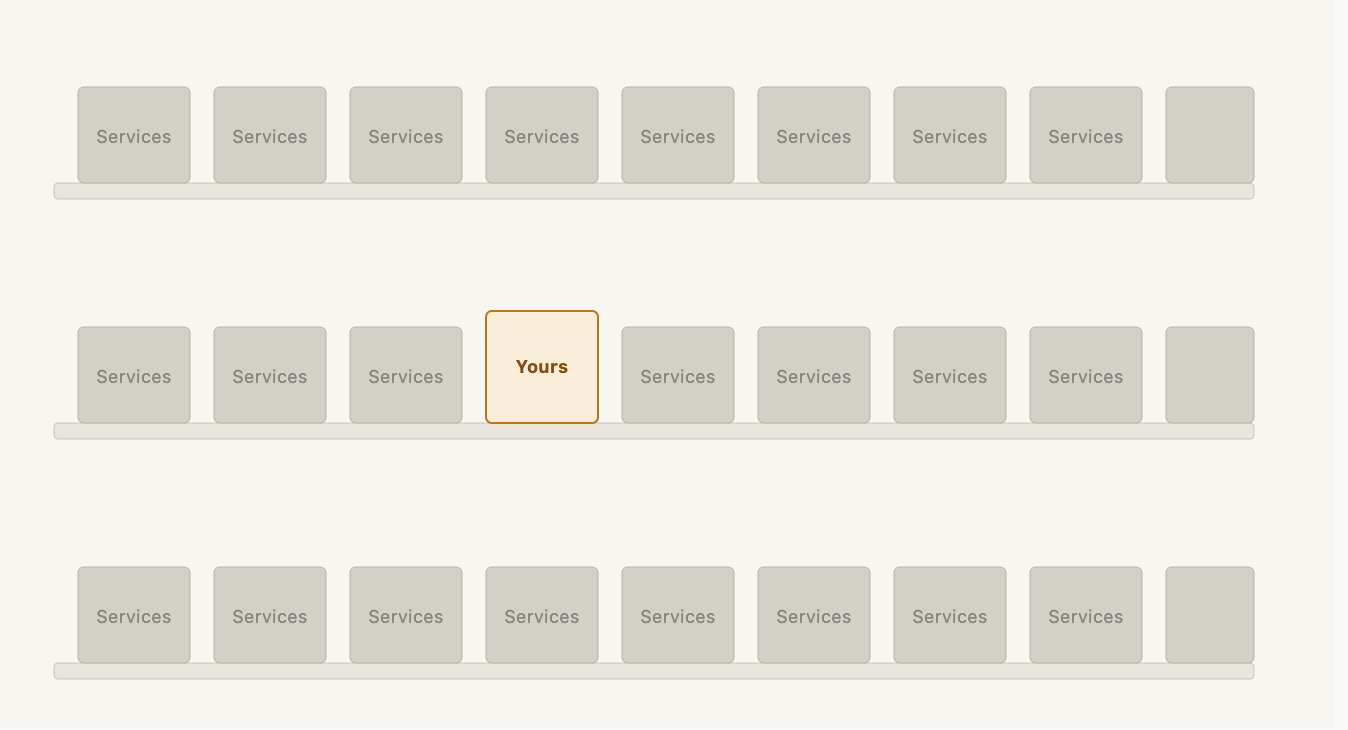
You’ve been in meetings like this before.
At first, the discussion went very well. The prospect understood what you did. They seemed to truly care about the work you could do. Then around the end of the meeting, something changed. At some point in the last part of the meeting, they mentioned that they are considering several other companies. They asked if you would be willing to adjust the cost. You felt the tone of the conversation begin to shift away from partnering and toward procurement.
Most Founders at this stage focus on finding ways to protect your pricing during the negotiation. How do I keep my prices from being reduced? How do I explain the value I bring to our prospective clients? How do I close this deal without cutting into my profit margins?
However, by the time the negotiations begin, the Client has already made up their mind about the perceived value of your services.
Commoditization happens long before the actual meeting takes place. This occurs when you describe your services on your website, in an e-mail or through impressions prior to someone from their company picking-up-the-phone.
This is uncomfortable because it shows that by the time your Client is negotiating your price, they already have a fairly established mental image of what your services are worth. When attempting to make a significant change to this mental image, it is similar to changing the course of a river. While it may be accomplished with enough power and effort, it requires significantly more force than shaping the riverbed early on.
Why perceiving your service as a “commodity” is more of a Positioning issue than a sales issue
Most founders don’t understand the difference between these two issues.
Perceiving your service as a commodity has nothing to do with poor salespeople. Nor does it have anything to do with pricing that’s actually too high. Lastly, it doesn’t have anything to do with the level of service quality provided.
Mostly, all of the services companies I deal with that face this problem are truly exceptional at what they do.
The real reason for perceiving your service as a commodity is Positioning — specifically, failing to establish a clearly defined and compelling differentiator for how your company positions itself within the marketplace.
Research from Mc Kinsey on B2B service firms determined that companies who were able to create a strong, positioned difference achieved much greater price premiums over their competition — not because customers are willing to pay more for the same product or service, but because the way in which these companies position themselves creates a buyer belief system about what they’re purchasing (not just the features/benefits).
If your positioning is generic — if your web site, pitch, and proposals define what you do using the exact words used to define what everyone else in your space does — then you are not asking buyers to compare you on quality. You are asking buyers to compare you on price. And in price comparisons, the cheapest option wins nearly 100% of the time
Companies providing services that can charge premium prices aren’t necessarily better than their competitors; they’ve simply created a situation where buyers cannot logically place them in the same category as their competitors. Thus, the comparison is essentially irrelevant.
Before you can fix positioning, you need to be aware of what commodity positioning actually looks like. And it is much more widespread than most founders realize — it is frequently that language that feels most natural, most professional, most safe.
Here are the patterns to watch for:
1. Category-language without differentiation. “We provide IT services.” “We’re a Digital Marketing agency.” “We offer software development solutions.” These sentences tell buyers what categories they belong in — nothing else. Category is not positioning. Category is just a starting point for comparison.
2. Capability-led messaging. “We have 50 engineers with expertise across 12 technologies.” “We’ve delivered 200 projects over the last five years.” Capabilities are table stakes in many B2B service categories. Leading with them encourages buyers to compare your capabilities against those of other firms — and the cheapest firm with similar capabilities will win.
3. Generic value claims. “We deliver quality.” “We’re committed to client success.” “We take pride in our communication.” These statements are not only unverifiable — they’re identical to what every other company in your Category says. They add noise, not signal.
4. Problem-free positioning. Most service-based firms describe their services without ever specifically naming the problems they help specific types of clients with. They describe what they do — not who they help; what those clients are struggling with; or what changes for those clients as a result of working with them.
If any of these patterns are present on your website; in your pitch deck; or in your proposals — then they are quietly undermining each sales conversation you have.
What premium positioning actually looks like
Premium positioning isn’t about saying you’re better than someone else. It’s about being impossible to compare.
The B2B services firms that command the highest rates share one characteristic: their positioning is so specific — so clearly defined around a particular type of client; a particular problem; and an outcome — that the comparison conversation never gets started.
Forrester research found that B2B buyers are 2.8 times more likely to pay a premium for a provider that they perceive as truly specialized in their specific challenge — versus a generalist with similar capabilities.
2.8 times. Not slightly more. Almost three times more likely to pay premium rates — for the same underlying capability — packaged with specific positioning.
That’s the repositioning opportunity that most services companies leave on the table every day.
A global semiconductor engineering services firm illustrates this perfectly. Their engineering capability was genuinely world class — the kind that major semiconductor manufacturers and government stakeholders relied on. But the way they described their services was too technical and promotional — with language that looked and felt just like every other engineering firm in their Category. Clients could not quickly grasp what made them unique. Neither could the candidates they desperately needed to hired.
Their positioning was costing them both clients — and talent — in an industry where the talent shortage is existential.
We re-engineered their message from scratch — working directly with their engineering teams to create language that was both technically credible and commercially compelling. The results were positions that were so specific and so easily distinctive by comparison that the comparison conversation became nearly irrelevant. Clients weren’t evaluating them against generalizations of alternative options. They were determining whether they could afford not to work with the one firm that obviously understood their world.
The engineering capability didn’t change. The way they communicated it to the market changed everything.
The Four Components Of An Exclusive Positioning
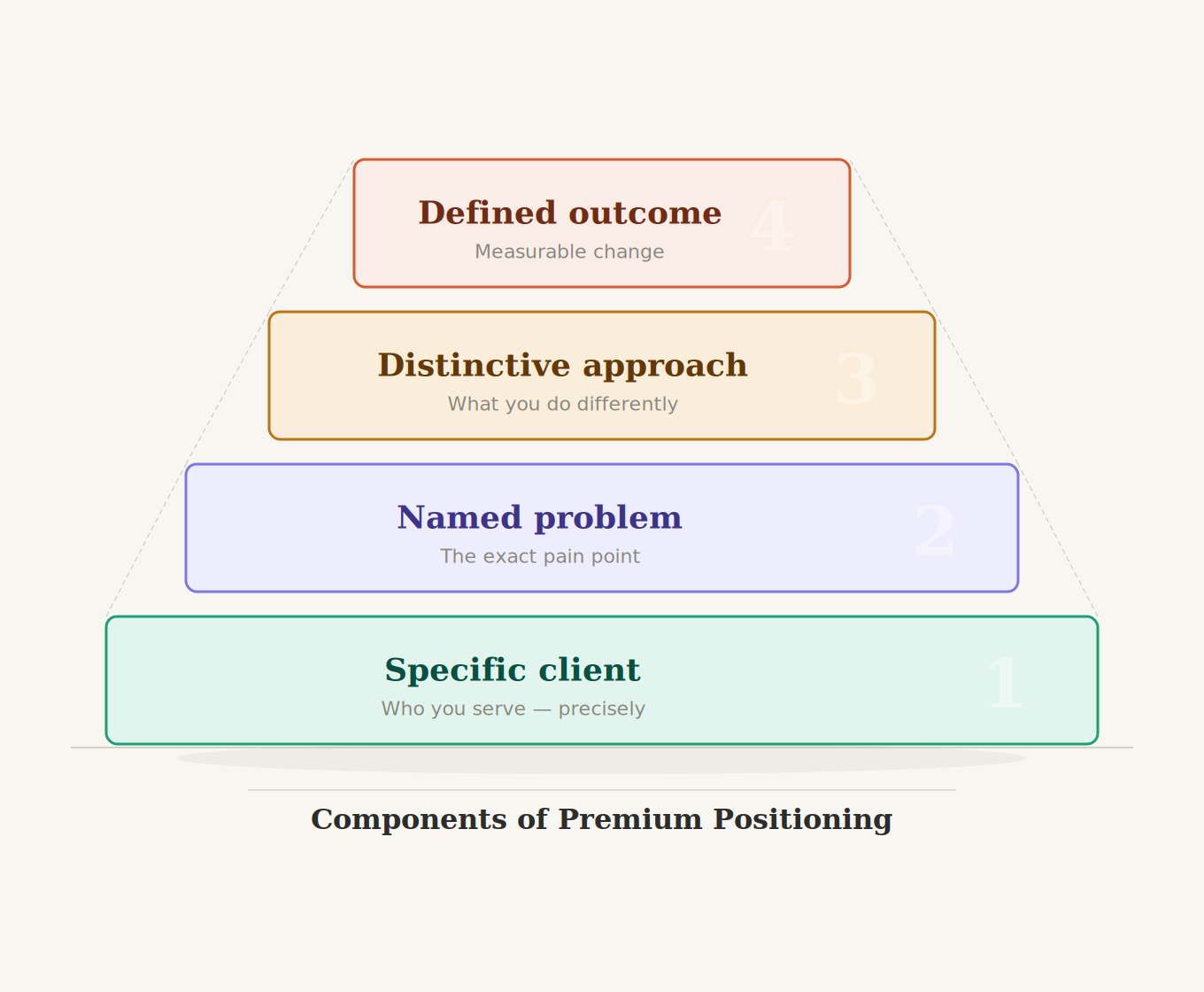
Repositioning is not rebranding. You may not need to replace your brand identity (i.e., logo) or create a new site from ground zero. However, you must ensure that four key components are correct—each time, for each contact point, at which a prospect contacts you.
1. A specific target audience. Not “Technology Companies Serving the Business-to-Business Market.” Not “Mid-Market Enterprises.” A clear image of the type of clients you provide the most value to — by industry; by lifecycle; by specific circumstances. The more specific your target audience is, the clearer your message.
2. The exact issue. The precise problem that your target client has before they engage with you. Not all of their problems, but the one problem that causes sleepless nights for your target client’s executive team. When a prospect reads your position statement and can say, “we are going through that too”, the sale is virtually complete.
3. A different way to do it. How you differ from others – not just what you do. This may include developing a proprietary process or defining a unique framework – however your different way must be defined so thoroughly that no other competitor uses the same words on their website.
4. Clearly stated outcome. What happens to your client as a direct result of them working with you – clearly stated; measured in a manner consistent with how they measure success; and using the terminology that matters to them. Not “improved marketing performance”. Revenue. Pipeline. Deal size. Win Rate. The numbers discussed during board meetings.
When all four components are both in place and aligned — on sites, proposals, pitches, and all interactions — the commodity discussion ceases. Not because you’ve won over anyone to your side of an argument. Because your position has worked ahead of you to eliminate the possibility of a commodity conversation.
What this looks like in practice
A global IT services firm approached us after ten years in operation. They have a good team. Outstanding delivery history. And they have a pricing problem that has existed for such a long period of time that it seems entrenched.
Their previous position statement included “Web and Mobile Development.” In a competitive marketplace with thousands of firms who describe themselves as “web and mobile developers” — they were no more differentiated than the least expensive developer in the market. Every sales conversation therefore was a price negotiation.
We repositioned them as a premium Product Development Partner — for companies developing large-scale, complex Digital Products requiring both strategic thinking and technical delivery capabilities — not simply coding.
The messaging around these four areas was revised throughout their site, proposals, pitches. Their Ideal Customer Profile (ICP) was defined with precision. Their case studies were rewritten to tell Transformation Stories rather than Project Completion Stories.
Not only did the number of leads grow 110%. The quality of those leads also improved two-fold. And their revenue grew 65%
No one on their team changed. No one’s capability changed. The way they presented their capability in the marketplace changed.
The Repositioning Test
Read the Home Page of your site right now — completely objectively — as if you’d never even heard of your company before.
Does it give you the sense that you’re reading about a company that truly comprehends a particular problem at deep levels? Or does it feel like it could easily have been written about any company in your space?
If the answer is the latter — that is where Commodity Perception begins. And it can be fixed. But only if you’ll allow yourself to be specific enough that some people will read it and say, “This isn’t for us.” That level of specificity is what will cause the right people to say, “This is exactly what we need.”
Exclusive positioning isn’t about being All Things To Everyone. It’s about Being Unmistakably Right For Someone.
And when you achieve this level of clarity — the Price Conversation will begin to change. Not because you’ve gotten better at negotiating prices. Because the prospect stopped thinking of you as something to negotiate about.
Key Takeaways
- Commodity perception is a positioning problem that exists before the sales conversation starts
When commodity language patterns are used generic value claims and capability-led messaging signals that the company is selling commodities; category labels without differentiation signal it as well
- Premium positioning is impossible to compare with anyone else. A strong positioning has the ability for Companies to charge 2.8 times more than their competition on average (Forrester Research)
- When you get this right – the price conversation changes. Not because of better negotiations. But because the prospect stopped thinking of you as something to be negotiated
Sources and Citations
McKinsey — Differentiated positioning and price premiums in B2B services
Forrester Research — 2.8X premium likelihood for specialised providers
David C. Baker — The Business of Expertise
Henry Ford — Competitive positioning and business improvement